
Introduction:
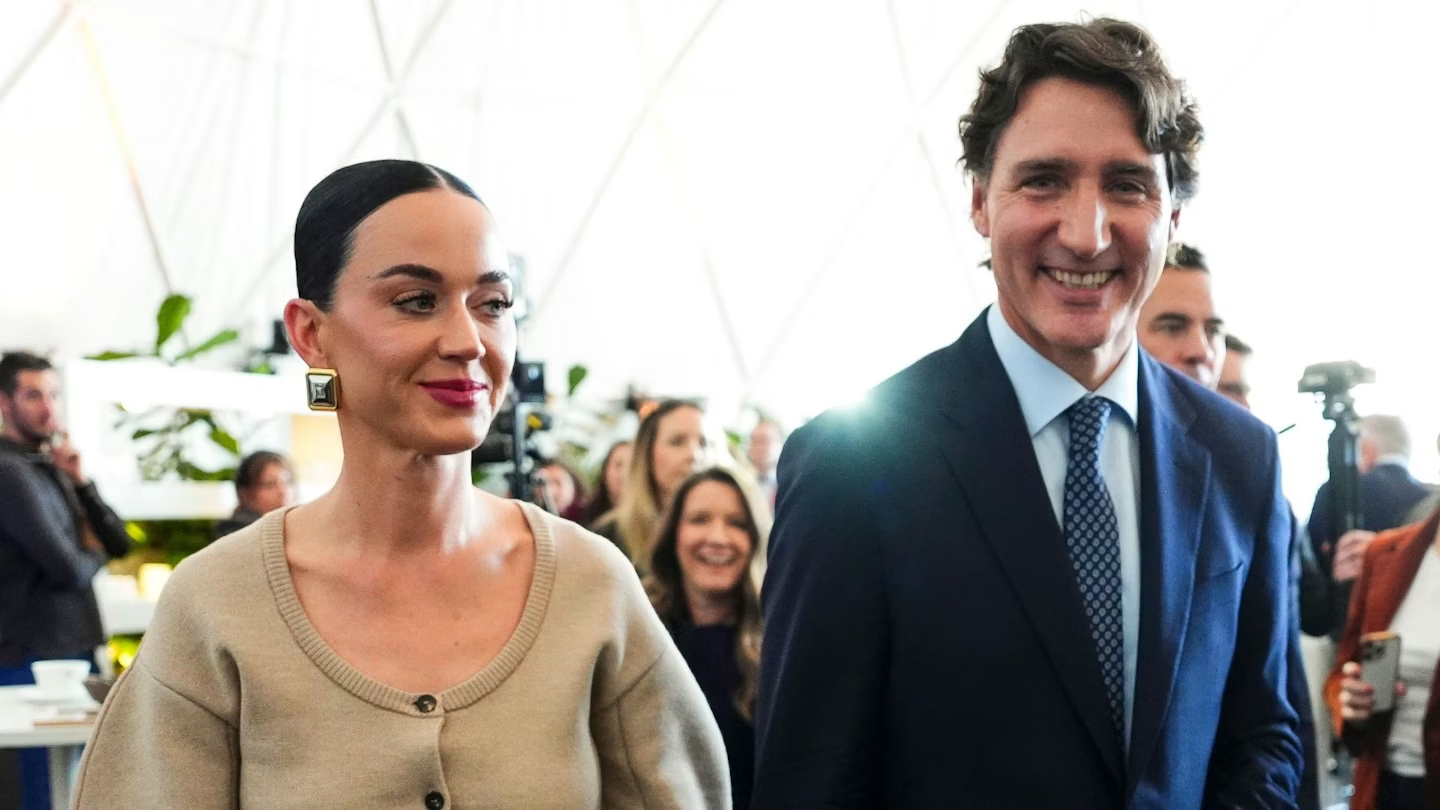
Have you ever noticed how the internet can take two completely unrelated names and suddenly make them trend together? That’s exactly what happens when people search or talk about “Justin Trudeau Katy Perry.” At first glance, it feels like an odd combination—one is the Prime Minister of Canada, and the other is a global pop superstar. So why do these two names appear together so often in online conversations?
In today’s world, where social media amplifies every rumor, interaction, or even coincidence, public figures often get linked in unexpected ways. Sometimes it’s due to real events like global summits or charity appearances. Other times, it’s simply the internet doing what it does best—creating narratives out of curiosity and speculation. This article takes a deep dive into why this keyword exists, what might be behind it, and how modern media culture fuels these kinds of associations.
We’ll explore the backgrounds of both figures, how celebrity-politics overlaps happen, and why audiences are so fascinated by these unlikely combinations. Let’s break it down in a clear, expert but casual way.
Who Is Justin Trudeau? A Quick Look at His Public Image and Influence
Justin Trudeau Katy Perry is the 23rd Prime Minister of Canada and has been a major political figure since 2015. Known for his progressive policies and strong media presence, he has built a global reputation that extends beyond traditional politics. Unlike many political leaders, Trudeau is often seen engaging with youth culture, social media trends, and international public events.
One of the key reasons Trudeau stands out is his ability to connect politics with modern communication. He is frequently featured in international discussions not just about policy, but also about leadership style, representation, and global diplomacy. His public image is carefully observed by both supporters and critics around the world.
Another important aspect of Trudeau’s presence is his involvement in global forums such as the United Nations and G7 summits. These platforms often bring him into contact with celebrities, activists, and business leaders. This intersection of politics and pop culture is where unexpected associations sometimes begin to form.
Who Is Katy Perry? From Pop Stardom to Global Cultural Influence
Justin Trudeau Katy Perry is one of the most recognizable pop stars in the world. With chart-topping hits, massive global tours, and a strong media presence, she has become more than just a singer—she is a cultural icon. Her influence extends into fashion, social causes, and even television as a judge on talent shows.
What makes Justin Trudeau Katy Perry particularly relevant in global discussions is her active participation in humanitarian causes. She has worked with organizations like UNICEF and has been involved in campaigns supporting children’s rights, education, and disaster relief. This philanthropic side often places her in the same international spaces as political leaders and diplomats.
Because of her global reach, Katy Perry frequently attends large-scale events, award shows, and charity galas. These gatherings often include influential figures from politics, business, and entertainment. This overlap is one of the reasons why her name can occasionally appear alongside political leaders like Justin Trudeau in online discussions.
Why Are Justin Trudeau and Katy Perry Mentioned Together Online?
At the core, there is no widely confirmed personal or political connection between Justin Trudeau Katy Perry. However, their names sometimes appear together due to a mix of internet speculation, event overlaps, and viral content patterns.
One possible reason is their shared presence in global events. Large international conferences, charity events, and awareness campaigns often bring together politicians and celebrities. Even a single photo, handshake, or brief interaction can spark online curiosity that grows rapidly through social media platforms.
Another factor is how modern search engines and algorithms work. When users search for celebrities and public figures, related or trending names often get grouped together. This can create the illusion of a deeper connection even when none exists.
In short, the pairing of “Justin Trudeau Katy Perry” is more about digital behavior than real-world collaboration.
The Role of Social Media in Creating Unexpected Celebrity Links
Social media platforms like X (formerly Twitter), Instagram, and TikTok play a major role in shaping public perception. A single post can turn into a global conversation within hours. When users see two famous names together, even casually, they may assume a connection and start sharing theories or jokes.
Memes are another powerful driver. Internet culture thrives on humor and exaggeration. A photo of a political leader at a music event or a celebrity at a political summit can easily be turned into viral content. Over time, these posts accumulate and create a searchable association between names that may not have any real connection.
This is how digital ecosystems amplify curiosity. Once enough people engage with a topic, algorithms begin promoting it more frequently, reinforcing the association even further.
Celebrity and Political Crossovers: A Common Modern Trend
It is not unusual anymore to see celebrities and political figures in the same space. In fact, this crossover has become quite common in the 21st century. Politicians often attend entertainment events to connect with younger audiences, while celebrities participate in political or humanitarian discussions to support global causes.
Justin Trudeau Katy Perry, for example, has attended events that include artists, activists, and entertainers. Similarly, Katy Perry has performed at or supported events that involve global leaders and policymakers. While this does not mean direct collaboration, it does explain why their worlds occasionally overlap.
This blending of industries reflects how interconnected modern influence has become. Politics, entertainment, and activism now share more common ground than ever before.
Misinterpretations and Internet Speculation Culture
One of the biggest reasons behind keywords like “Justin Trudeau Katy Perry” is the internet’s tendency to over-interpret small interactions. A handshake, a group photo, or even attendance at the same event can lead to assumptions about relationships or collaborations.
In many cases, content creators also contribute to this cycle by publishing speculative videos or articles designed to attract clicks. These pieces may not always be based on verified information, but they generate attention because they combine two highly recognizable names.
This creates a feedback loop: curiosity leads to searches, searches lead to algorithmic promotion, and promotion leads to even more curiosity. Over time, the association becomes part of online search behavior, even without any factual basis.
The Power of Names in Search Engine Behavior
Search engines play a surprisingly important role in shaping how we perceive connections between public figures. When enough users search for “Justin Trudeau Katy Perry,” even out of curiosity, search engines begin suggesting it as a related query.
This does not necessarily mean there is a real-world link. Instead, it reflects user behavior patterns. Algorithms are designed to respond to demand, not verify context. As a result, unrelated individuals can become linked in search suggestions simply because people are interested in both.
Over time, this can create a perception of association that feels more significant than it actually is.
Media Coverage and the Blurring of Fact and Curiosity
Mainstream media outlets usually avoid implying connections that are not verified. However, online blogs, entertainment pages, and social platforms often operate differently. They prioritize engagement, which can sometimes lead to ambiguous headlines or speculative framing.
When two high-profile names are mentioned together, even in unrelated contexts, it can easily be misinterpreted. Readers may assume a deeper connection than what actually exists. This is especially true when headlines are designed to be attention-grabbing rather than informational.
In the case of Justin Trudeau Katy Perry, most credible sources do not indicate any significant personal or professional relationship. However, the curiosity around both figures keeps the keyword alive in digital spaces.
Why the Public Loves Unexpected Celebrity Pairings
There is something inherently fascinating about imagining connections between people from completely different worlds. A politician and a pop star represent two distinct spheres of influence—governance and entertainment. When those worlds appear to overlap, even slightly, it captures attention.
This fascination is not new. Throughout history, audiences have been intrigued by unexpected pairings of influential figures. It reflects a broader human tendency to look for stories, patterns, and meaning—even where none may exist.
In the digital era, this tendency is amplified by instant access to information and rapid content sharing.
The Importance of Critical Thinking in Viral Content
As entertaining as these associations may be, it is important to approach them with a critical mindset. Not every trending keyword reflects a real-world connection. In fact, many are the result of algorithmic patterns, speculation, or simple coincidence.
Understanding how digital platforms work helps reduce misinformation and prevents unnecessary assumptions. It also encourages users to differentiate between verified information and online curiosity trends.
In the case of “Justin Trudeau Katy Perry,” there is no confirmed evidence of any significant connection beyond general public appearances in global spaces.
Conclusion:
The pairing of Justin Trudeau Katy Perry in online searches is a perfect example of how the internet creates unexpected narratives. It is not based on a known partnership or confirmed relationship, but rather on the intersection of visibility, curiosity, and algorithmic behavior.
Both individuals are highly influential in their respective fields, and both frequently appear on global stages where different industries meet. This overlap is enough to spark speculation, even if there is no deeper story behind it.
Ultimately, this keyword reflects more about internet culture than about either individual. It shows how quickly information spreads, how easily assumptions form, and how powerful digital platforms are in shaping perception.
In a world where politics and pop culture increasingly coexist in the same spaces, such associations will likely continue to appear. The key is to understand them for what they are—digital curiosities rather than confirmed connections.







Leave a Reply